PSER Survey for Rs 10000 Cash
PSER Survey for Rs 10000 Cash For millions of families in Punjab, Ramadan is a time of faith, patience, and togetherness, but it is also a time when household expenses rise sharply. In recent years, while covering government relief initiatives across Punjab, one pattern has appeared again and again: people do not miss Ramadan relief because they are undeserving, they miss it because their data is missing from government records.
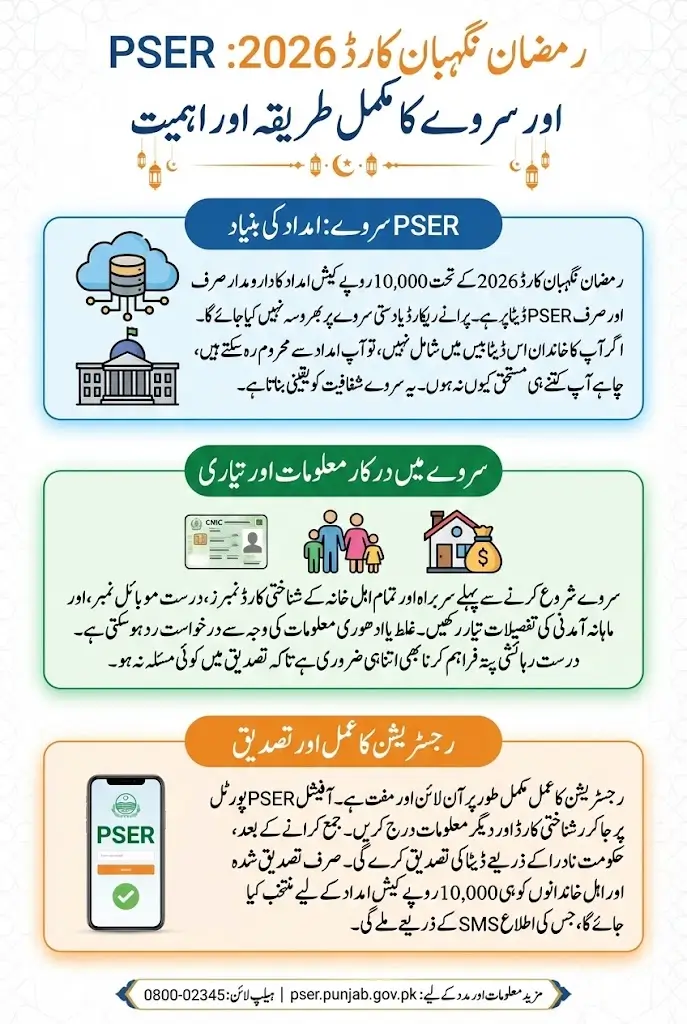
To address this issue, the Punjab government has linked the Ramzan Negahban Card 2026 directly with the Punjab Socio-Economic Registry (PSER). Under this system, families that complete and verify their PSER survey can receive Rs 10,000 cash assistance before Ramadan. This guide explains the full process clearly, so ordinary citizens can understand what to do, why it matters, and how to avoid mistakes.
You Can Also Read: PSER Survey 2026 Punjab
Introduction to PSER-Based Ramzan Cash Support
The Ramzan Negahban Card 2026 is designed as a cash-based relief program rather than a ration distribution scheme. Based on past experiences, many families found ration bags limited, delayed, or unsuitable for their specific needs. Cash support gives families the freedom to buy flour, ghee, pulses, medicines, or other essentials according to their priorities.
This relief program is not decided at local offices or through recommendations. It is entirely linked to PSER, which acts as a centralized data system. Families whose information is not recorded or verified in PSER are automatically excluded, regardless of how poor they may be. This is why understanding and completing the PSER survey is the most important step for receiving Rs 10,000 under the Ramzan Negahban Card.
You Can Also Read: PSER Online Registration 2026
Why PSER Survey Is Mandatory for Rs 10,000 Assistance
PSER exists to ensure transparency and fairness in welfare distribution. From what has been observed during previous Ramadan and subsidy programs, manual selection always led to complaints and confusion. PSER removes that uncertainty by relying on documented household data.
The PSER survey helps the government:
- Identify low-income households using income and dependency data
- Verify CNIC details through NADRA
- Avoid duplication and fraudulent claims
Without PSER data, the system has no way to judge eligibility. That is why families who skip the survey, even unintentionally, are not considered for the Rs 10,000 Ramadan cash assistance.
Who Can Be Considered for Ramzan Negahban Card 2026
Eligibility for the Ramzan Negahban Card 2026 is determined through PSER records, not personal requests. The government focuses on households that are genuinely struggling with rising costs during Ramadan.
Generally, eligible families include:
- Permanent residents of Punjab
- Households with low or limited monthly income
- Families headed by a valid CNIC holder
In many cases, families already receiving other assistance programs are also reviewed. However, if their PSER data is outdated or incomplete, they may still be excluded. This is why updating PSER information is just as important as registering for the first time.
Documents and Information Needed Before Starting PSER Survey
Before starting the PSER survey, families should prepare all required information carefully. From experience, most rejected applications are not due to poverty status but due to incorrect or missing details.
You should have:
- CNIC of the head of household
- CNIC numbers of spouse and dependents
- Estimated monthly household income
- Accurate residential address
Taking a few minutes to gather this information reduces errors and prevents delays during verification.
Complete PSER Survey Submission Process Explained
The PSER survey process is fully digital and user-friendly, designed so people do not need to visit any office. Anyone with basic mobile or internet access can complete it.
The process includes:
- Opening the official PSER website
- Entering CNIC and contact information
- Filling household, income, and family details
- Submitting the survey for verification
Registration is completely free. No government department has authorized agents or fees. Anyone demanding payment for PSER registration is misleading people.
How Government Verifies PSER Data for Cash Approval
After submission, PSER data enters the verification phase. This step ensures that only deserving households are selected for the Ramzan Negahban Card 2026.
Verification is done by:
- Matching CNIC details with NADRA
- Reviewing income and family size
- Checking duplication or false entries
Only households that meet the criteria after verification are shortlisted for Rs 10,000 cash assistance. This data-based approach helps ensure fairness across Punjab.
Checking Rs 10,000 Cash Status After PSER Survey
Once the survey is completed, families often want immediate confirmation. However, verification takes some time.
Status can be checked by:
- Visiting the PSER portal online
- Sending CNIC number via SMS to 8070
If a family is eligible, they receive a confirmation message. In most cases where no response is received, the issue is incomplete or incorrect PSER data rather than rejection.
Payment Mechanism of Ramzan Negahban Card Cash Assistance
The Punjab government has adopted a controlled payment mechanism to ensure transparency and timely delivery of funds. The Rs 10,000 assistance is issued only after CNIC verification.
| Program Detail | Information |
|---|---|
| Program Name | Ramzan Negahban Card 2026 |
| Cash Amount | Rs 10,000 |
| Eligibility Basis | PSER Verified Data |
| Payment Method | Cash or Card-Based |
| Coverage Area | Punjab Province |
Beneficiaries are informed about payment collection through official channels only.
Common PSER Survey Errors That Affect Approval
During previous welfare drives, certain mistakes repeatedly caused delays and rejections. These errors are avoidable if attention is paid during data entry.
Common problems include:
- Incorrect CNIC digits
- Wrong income declaration
- Missing family members
- Mobile number not linked with CNIC
Even small inaccuracies can affect eligibility, so accuracy is critical.
How to Update or Correct PSER Information Safely
PSER allows households to update information when circumstances change. This feature exists to keep records realistic and fair.
Updates are needed if:
- Income level changes
- Family size increases
- Address information is outdated
All updates must be made through the official PSER portal. False updates can lead to permanent disqualification from future programs.
Official Support Channels for PSER and Negahban Card
To help citizens, the Punjab government provides official support services. These channels should be used instead of relying on social media or agents.
Support is available through:
- Helpline: 0800-02345
- Official portal: pser.punjab.gov.pk
These services are free and meant to guide citizens properly.
Final Words
From years of observing government relief programs, one lesson is clear: data matters more than words. The Ramzan Negahban Card 2026 is a valuable opportunity, but only for families whose PSER information truly reflects their situation.
Complete your PSER survey carefully, use only official platforms, and avoid shortcuts. Accurate data today can secure not just Ramadan assistance, but future government support as well.