PSER Survey 2026 Punjab
PSER Survey 2026 Punjab Door-to-Door Registration Process Full Guide Punjab Social and Economic Registry (PSER) Survey 2026 has once again become a lifeline for millions of low-income families across Punjab. After months of anticipation, the Punjab government has resumed this large-scale survey to update household records and ensure that welfare assistance reaches the truly deserving. From crowded city neighborhoods to far-flung rural villages, survey teams are now actively visiting homes to collect fresh data.
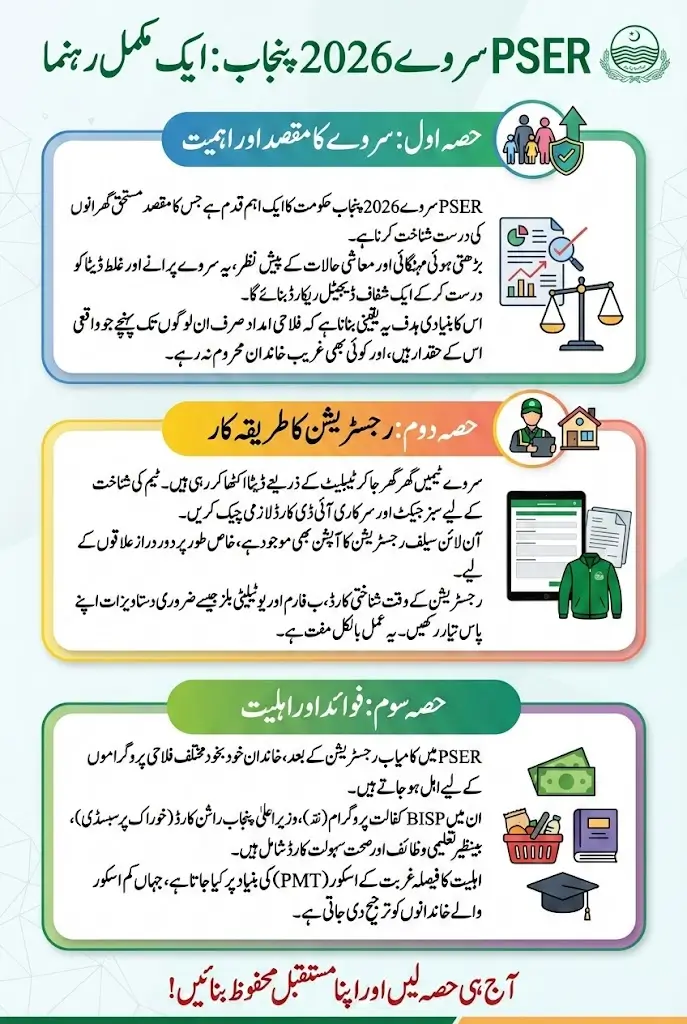
Over the years, I have personally seen families struggle not because aid programs did not exist, but because their data was missing, outdated, or incorrect. The PSER Survey 2026 is designed to correct these issues by creating a transparent, verified, and digital record of household conditions. This updated data will decide eligibility for major programs such as BISP, CM Punjab Rashan Card, Benazir Taleemi Wazaif, and health-related support schemes.
Why the Punjab Government Restarted PSER in 2026
Economic conditions in Pakistan change rapidly. Inflation, job losses, medical expenses, and natural challenges have pushed many previously stable families into financial hardship. The Punjab government recognized that relying on old survey data was no longer fair or practical, which is why the PSER survey has been restarted in 2026 with improved methods.
The goal is simple: identify who actually needs help today. By removing outdated entries and adding newly deserving families, the government aims to create a balanced welfare system where assistance is not wasted and reaches households living below the poverty line.
Major reasons behind restarting PSER include:
- Rising inflation affecting household purchasing power
- Increased demand for cash assistance and ration subsidies
- Errors and exclusions in earlier surveys
- Need for real-time, digitally verified household data
Role of Chief Minister Maryam Nawaz in PSER Expansion
Under the leadership of Chief Minister Maryam Nawaz Sharif, the PSER Survey 2026 has been expanded with a strong focus on transparency and accountability. Unlike previous efforts, this survey relies heavily on physical verification combined with digital systems to minimize manipulation and favoritism.
From what can be observed on the ground, the current administration is serious about ensuring that welfare benefits are distributed based on real need rather than influence. By integrating PSER data with NADRA and federal welfare databases, the government has taken a significant step toward building public trust in social protection programs.
Areas and Communities Covered in the 2026 Survey
The PSER Survey 2026 is being conducted across all districts of Punjab, covering both urban and rural regions. Survey teams are visiting areas that were previously ignored or only partially covered, ensuring that no deserving family is left out due to location.
Special attention is being given to:
- Remote and underdeveloped villages
- Informal settlements and katchi abadis
- Daily wage earners and labor-class households
- Families excluded from earlier surveys
This wide coverage ensures equal representation and inclusion in Punjab’s welfare system.
Who Should Participate in the PSER Survey
Any household that depends on government assistance or believes it qualifies for welfare support should take part in the PSER Survey 2026. Participation is especially important for families whose financial situation has worsened in recent years.
You should ensure participation if:
- Your household income has decreased
- You were previously declared ineligible
- You want access to BISP or Punjab welfare schemes
- Your family size, income, or residence has changed
Step-by-Step Door-to-Door Registration Method
The door-to-door registration process is the backbone of the PSER Survey 2026. Trained survey teams visit households equipped with tablets and secure mobile applications. All information is entered digitally on the spot, reducing paperwork and chances of error.
During a visit, surveyors typically:
- Verify CNICs of all adult family members
- Record income sources and employment status
- Collect education and dependency details
- Assess housing conditions and basic facilities
The process is completely free, and families should never pay anyone for registration.
How to Identify Official PSER Survey Teams
Due to the scale of the survey, the government has issued strict identification rules for survey teams. Genuine PSER officials wear green government-issued jackets and carry official identity cards.
Before sharing information, families should:
- Ask to see the official PSER ID card
- Check for government logos on devices
- Avoid sharing data with unknown individuals
- Report suspicious activity to local authorities
Information Collected During Household Verification
PSER data collection goes beyond basic personal details. It focuses on understanding the complete living condition of a household so that poverty scoring is accurate and fair.
Survey teams collect information such as:
- Monthly income and income sources
- Number of dependents and children
- School enrollment status
- Electricity, gas, water, and sanitation access
This detailed information helps ensure that assistance reaches those who genuinely need it.
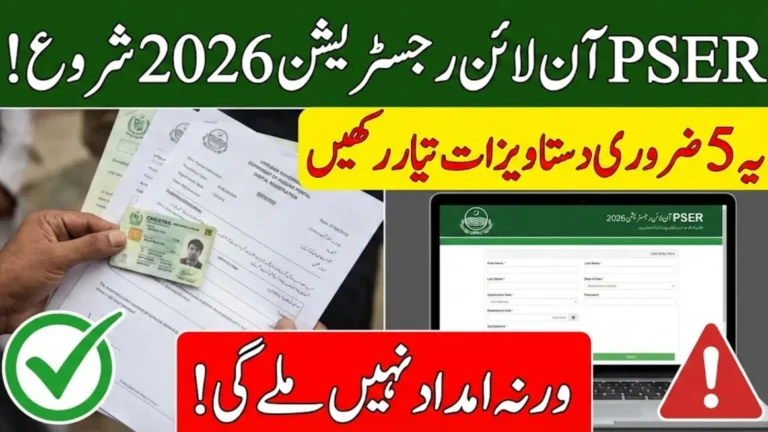
Required Documents for Smooth PSER Registration
Incomplete documentation is one of the main reasons surveys get delayed. Families are advised to keep all relevant documents ready before the visit.
Essential documents include:
- CNICs of adult household members
- B-Form for children
- Utility bills for residence verification
- Proof of income or sworn affidavit
- Rent agreement or ownership papers
Online PSER Self-Registration Option Explained
For households that have not yet been visited, the Punjab government has provided an online self-registration option. This is especially useful for people living in remote areas or newly developed housing schemes.
The online system allows families to enter their data themselves, which is later verified through the same official channels as door-to-door registrations.
Complete Online Registration Workflow
The online registration process has been designed to be simple and user-friendly for ordinary citizens.
The process includes:
- Visiting the official PSER portal
- Creating an account using CNIC and mobile number
- Filling out household and income details
- Submitting the form for verification
Once submitted, the application enters the official review process.
How CNIC Verification Works in PSER 2026
All PSER data is verified through NADRA to ensure authenticity. CNIC verification prevents duplicate entries and false registrations, which were common problems in older systems.
This verification ensures that:
- Only one household receives benefits
- Fake or duplicate CNICs are rejected
- Welfare resources are protected
Poverty Score System and Eligibility Logic
Each household is assigned a Poverty Means Test (PMT) score ranging from 0 to 100. The lower the score, the higher the financial need.
Generally observed thresholds include:
- PMT score of 32 or below for cash assistance
- PMT score up to 40 for ration-based subsidies
Welfare Programs Linked With PSER Data
Once a household is approved in PSER, it automatically becomes eligible for multiple welfare programs without separate applications. This single-database approach saves time and reduces confusion for families.
Benefits Available Through PSER Registration
| Welfare Program | Type of Assistance | PMT Score Requirement |
|---|---|---|
| BISP Kafalat | Rs. 13,500 quarterly cash | 32 or below |
| Benazir Taleemi Wazaif | Education stipends | Mother’s PMT ≤ 32 |
| CM Punjab Rashan Card | Food subsidy support | 40 or below |
| Sehat Sahulat Card | Free medical treatment | 32 or below |
Digital and Technology Improvements in 2026 Survey
The PSER Survey 2026 uses modern digital tools to improve accuracy and transparency. Data is entered and synced in real time, reducing manual errors and manipulation.
Key improvements include biometric verification, AI-based poverty assessment, and instant database integration.
Data Review and Approval Stages After Survey
After submission, PSER data is cross-checked with NADRA, BISP, and other government databases. Any discrepancies are flagged for review before final approval.
SMS Confirmation and Benefit Activation Process
Once approved, families receive SMS notifications confirming their eligibility. Benefits are then activated automatically without the need for further applications.
Common Mistakes That Can Delay Eligibility
Many households face delays due to avoidable mistakes.
Common issues include:
- Incorrect CNIC information
- Incomplete documentation
- False income declarations
- Lack of cooperation during verification
Why Completing PSER Is Important for Future Assistance
PSER is not limited to current schemes. The data collected will be used for future relief programs, emergency aid, and subsidy planning. Completing the survey now secures long-term inclusion.
Key Instructions for Families During the Survey
Families should provide honest information and cooperate fully with survey teams. Transparency ensures faster approval and long-term benefits.
Final Summary
The PSER Survey 2026 is a critical opportunity for deserving families in Punjab. By completing the survey accurately, households secure access to cash assistance, food subsidies, healthcare, and education support through a single verified system designed to serve those who truly need it.