
PSER Role In PMRRP Online Portal 2026
PSER Role In PMRRP Online Portal 2026 Across Punjab, the relief structure has shifted from manual lists to verified household records. In practical terms, the Punjab Socio-Economic Registry (PSER) works as the master database that captures a family’s financial and living conditions, while PMRRP uses that verified information to decide eligibility for ration support, subsidy activation, and other assistance. From conversations at facilitation centers, the biggest change people notice is transparency: once data is verified, decisions follow a clear digital path rather than informal recommendations.
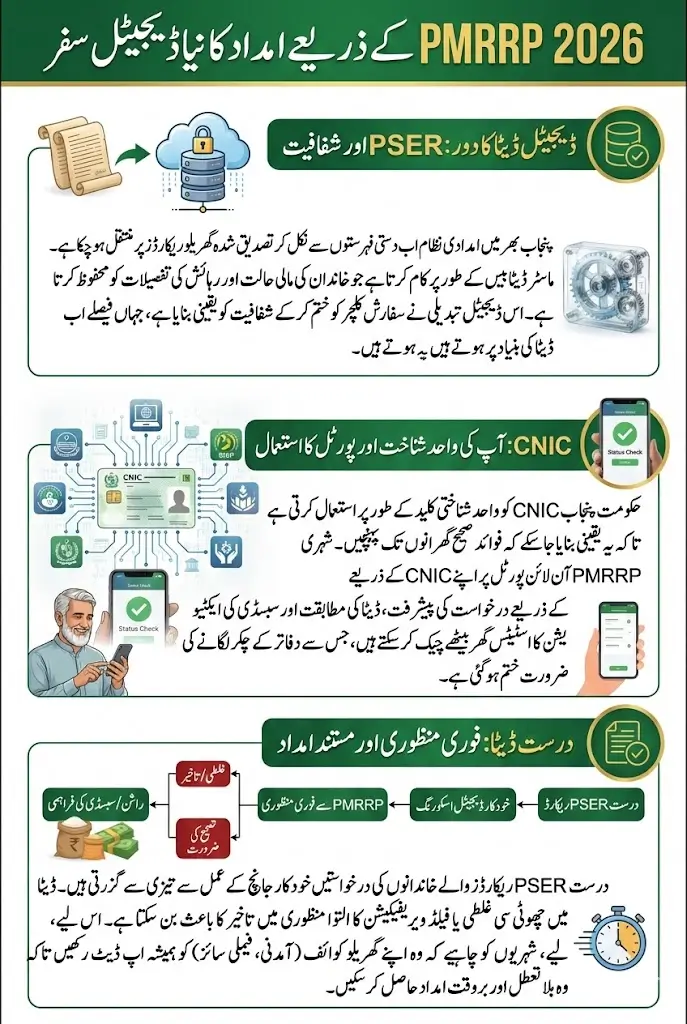
The system is administered under the Government of Punjab, which relies on CNIC-linked profiles to ensure that benefits reach the right households. When a family submits details—income, family size, housing status—the information is scored and validated. Only then does PMRRP process approval. This integration reduces duplication, speeds up decisions, and creates a consistent rulebook for everyone applying in 2026.
• PSER stores verified household information used by PMRRP
• CNIC is the single identity key for matching records
• Digital scoring determines eligibility level
• Verified data can unlock multiple welfare programs
You Can Also Read: Nigehban Ramzan Package 2026 New Payment 10000
What Citizens Can Do Through the PMRRP Online Portal
For ordinary citizens, the PMRRP portal functions as a practical status and verification platform. Instead of visiting multiple offices, families can check whether their data has been received, reviewed, or approved using their CNIC. From field observations, applicants value the ability to see progress without relying on agents or unofficial sources.
The portal also reflects how different welfare databases are connected. Records are cross-checked with national programs, including the Benazir Income Support Programme, to avoid duplicate benefits and to ensure fair distribution. When the system confirms eligibility, subsidy activation and ration authorization follow according to program timelines.
• Check application progress using CNIC
• Confirm data matching with national welfare records
• Monitor subsidy or ration activation stage
• Access official updates without visiting offices
You Can Also Read: Ehsaas Rashan Subsidy 2026 Reopened Apply
Journey of an Application: From Survey to Decision
Every application follows a structured verification journey. First, a household profile is created in PSER based on submitted information. Next, the system validates entries against government databases and assigns a socio-economic score. Finally, PMRRP reviews the verified profile and determines eligibility. This layered approach explains why accurate data at the beginning is critical; small errors can slow the entire process.
In real cases observed at help desks, delays usually occur when information does not match existing records or when field verification is pending. The system pauses approval until discrepancies are resolved, which protects public funds and ensures fairness among applicants. Families who keep their data updated generally experience smoother processing.
You Can Also Read: PSER 8070 Registration Online 2026 Punjab Online Apply
| Processing Phase | What the System Checks | Outcome for Applicant |
|---|---|---|
| Profile Creation | Household details recorded via PSER | Official record established |
| Digital Validation | CNIC and data matched with databases | Duplicate or false entries filtered |
| Socio-Economic Scoring | Income and assets evaluated | Eligibility level determined |
| Final Authorization | PMRRP reviews verified profile | Benefit approval or correction request |
Why Status Updates May Take Time to Appear
A common concern among applicants is the waiting period. Based on what applicants report and officials confirm, most delays are administrative rather than negative decisions. During high-demand periods—especially before major relief phases—verification teams handle large volumes of applications, which extends processing time.
Another factor is field validation. Survey teams may confirm household details to ensure that declared information reflects real conditions. If any mismatch appears, the system requires clarification before moving forward. While this may feel slow, it strengthens the credibility of the program and ensures that assistance reaches deserving families.
• High volume of applications during relief cycles
• Field verification scheduling and reporting time
• Data mismatches requiring manual review
• Technical load on verification systems
You Can Also Read: Maryam Ko Batayein 1000 Helpline To Get 10,000 Ramadan
Why Accurate PSER Records Improve Approval Chances
Families with complete and correct PSER records often receive quicker decisions because their data passes automated checks without interruption. Accurate profiles also remain valid for future schemes, meaning a single verified record can support eligibility across multiple programs without repeated registration.
From community-level observations, applicants who update household changes—such as income variation or family size—avoid unnecessary delays. In the evolving digital welfare environment, accurate data is not just helpful; it is essential for continuous eligibility and timely benefit delivery.
• Updated data enables faster verification
• One verified profile supports multiple schemes
• Correct records reduce need for repeated applications
• Transparent scoring improves fairness
You Can Also Read: PSER Online Registration 2026 For Muft Atta
Frequent Data Problems That Interrupt Processing
Most processing interruptions arise from simple documentation errors rather than ineligibility. Incorrect CNIC spelling, outdated income information, or duplicate household entries can trigger verification pauses. These issues are usually correctable, but they require timely attention from applicants.
Officials emphasize that the system is designed to identify inconsistencies automatically. When data is corrected, applications typically resume normal processing. This approach balances accessibility with accountability in public welfare distribution.
• Incorrect or incomplete CNIC details
• Outdated income or employment information
• Duplicate family records in the system
• Unreported changes in household size
You Can Also Read: 9999 PM Ramzan Relief Package Online Check Status
Where to Seek Assistance Without Paying Agents
Despite digital access, many citizens still benefit from official support channels. Facilitation centers help applicants understand status messages, update records, and resolve verification issues. Based on feedback from visitors, using authorized channels prevents misinformation and protects applicants from fraud.
Helpline services provide additional guidance for those who cannot visit offices. Applicants who rely on official support generally avoid unnecessary expenses and receive accurate instructions regarding their status and next steps.
• Visit authorized facilitation centers for corrections
• Use official helpline for status guidance
• Avoid paying middlemen for approvals
• Keep personal data confidential
Data Security and Safe Use of Government Portals
As digital welfare expands, protecting personal information has become a public priority. Citizens are advised to access only official government portals and never share CNIC, OTP, or passwords with unknown callers. Fraud attempts often target applicants awaiting approval by promising faster processing for a fee.
Public awareness efforts stress that welfare services remain free. Any demand for payment in exchange for approval is unauthorized and should be reported immediately. Safe usage ensures that applicants benefit from the system without risk.
• Access only official government websites
• Never disclose OTP or login credentials
• Report suspicious calls requesting payment
• Keep CNIC information private
Typical Timeline From Registration to Benefit Activation
Processing duration varies depending on verification workload and data accuracy. In most observed cases, applications move steadily when submitted information matches official records. Families should monitor status periodically and follow up only when delays exceed expected timelines.
Experience from recent application cycles shows that proactive monitoring helps applicants respond quickly if corrections are required. Patience combined with accurate information usually leads to successful approval.
• Initial review commonly completed within several weeks
• Field verification may extend processing time
• Corrections often update status faster
• Approval triggers benefit activation
What Applicants Should Remember in 2026
The central lesson for applicants is straightforward: PSER verification is the gateway to PMRRP assistance. CNIC-linked data allows the system to evaluate eligibility objectively and distribute resources fairly. Understanding how data flows from registration to approval helps families navigate the process with confidence.
In Pakistan’s increasingly digital welfare environment, awareness and accuracy are the strongest tools citizens possess. Families who maintain updated records, check status responsibly, and rely on official channels position themselves to receive timely and transparent support.