Pser.Punjab.Gov.Pk
Pser.Punjab.Gov.Pk launch of the pser.punjab.gov.pk registration system by the Government of Punjab has changed the entire experience of applying for Ramzan assistance in Punjab. For years, welfare applicants faced long queues, manual forms, and slow verification processes that often resulted in delays and errors. In contrast, the 2026 digital system allows families to register from their homes, check their eligibility, and receive real-time updates on their application status. This transformation is a major step toward modernizing social protection across the province.
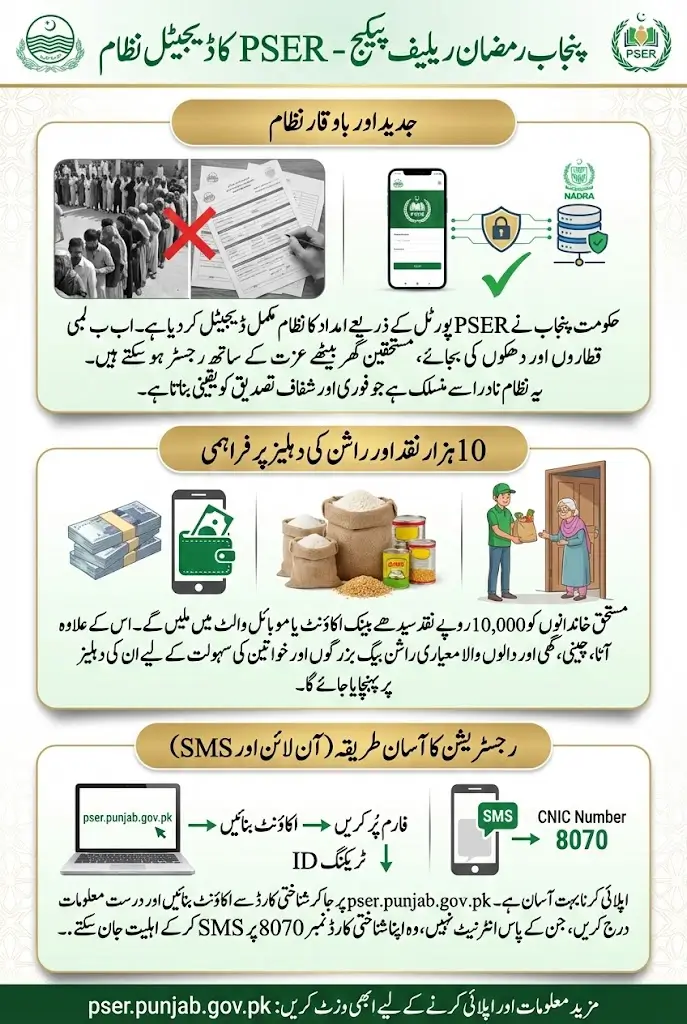
In my field reporting, I have observed how people—especially daily wage workers, widows, elderly citizens, and low-income families—struggled to access relief packages due to outdated processes and overcrowded distribution centers. With the PSER portal, the government has moved toward a more efficient model where digital verification replaces paperwork and tracking IDs replace handwritten slips. The platform offers a smoother, clearer, and more reliable way to distribute Ramzan Relief without the usual frustration and confusion.
The system works through a centralized database that connects directly with NADRA records. This allows real-time identity checks, poverty score assessment, and household verification, reducing the possibility of fraud and ensuring that aid reaches the genuinely deserving. It is a reform that has long been needed, especially in rural areas where access to government offices is limited and information often travels slowly.
You Can Also Read: Kpk Ramzan Package 2026 Online Apply
What is pser.punjab.gov.pk Portal?
The pser.punjab.gov.pk portal is an advanced digital platform developed under the Punjab Socio-Economic Registry. This system collects socio-economic information from millions of households and builds a poverty profile to determine who qualifies for government support. Instead of relying on old lists or manual surveys, the portal uses integrated data sources to verify household income, assets, and family size. This accuracy is critical during high-demand periods like Ramzan, when the pressure to deliver aid on time is highest.
In urban and rural areas alike, people often worry about the complexity of government websites, but the PSER portal has been designed for accessibility. Its interface is simple, and each step is clearly explained so even first-time users can follow the instructions without difficulty. The system also supports Urdu text, making it easier for people who are not comfortable with English to complete their forms independently.
The portal connects to multiple databases to avoid duplication. One of the biggest improvements is transparency families can see whether they are accepted, under verification, or rejected, instead of waiting blindly for SMS responses. For journalists like me who closely observe welfare programs, this platform represents a major leap toward citizen-friendly governance.
You Can Also Read: Maryam Ko Batayein Rs 10,000 Scheme App Download
Overview of Ramzan Relief Package 2026
The Ramzan Relief Package 2026 has been designed with a deeper understanding of what low-income households truly require during the holy month. Food prices rise sharply every year, and for many families, it becomes nearly impossible to manage expenses. Instead of relying on distribution camps and gatherings, the package uses a modern system that forwards assistance directly to the beneficiary after verification. This change reduces mismanagement, crowding, and the humiliation that vulnerable citizens previously faced.
The package includes both cash and ration support. The cash assistance of Rs. 10,000 helps families choose their own food items, manage utility bills, or handle any other expense that becomes urgent during Ramzan. Meanwhile, the free ration bag includes essential groceries that every Pakistani household uses daily. This dual model ensures that the relief is both flexible and adequate for families with different needs.
Another major improvement is the automatic inclusion of families already receiving assistance through BISP. This prevents duplication of effort and ensures quick distribution since these households are already verified under national welfare databases. On-ground staff also confirm residential addresses and family details to ensure timely delivery.
You Can Also Read: Pakistan Approves Immediate Release of Rs19bn
Financial and Food Assistance Offered Under the Package
One of the most beneficial elements of the 2026 package is the direct bank transfer of Rs. 10,000. Previously, applicants had to collect cash physically from centers, which often meant standing in heat, dealing with crowds, or facing delays. With the current system, the process becomes smoother and safer. The money is sent directly to the beneficiary’s registered mobile wallet or bank account once verification is complete.
At the same time, the ration bag distributed this year has been standardized to ensure fairness. During my coverage of past Ramzan relief events, I encountered many families who complained about low-quality or incomplete ration bags. This time, every bag contains the same items in the same quantity. The list has been designed considering the average monthly consumption of Pakistani households.
The ration bag contains:
- Flour
- Sugar
- Rice
- Ghee
- Pulses
Doorstep delivery is a major advancement. Instead of forcing women, elderly citizens, or people with disabilities to travel long distances, survey teams and delivery teams collaborate to bring the ration to their home once approved.
You Can Also Read: PSER Role In PMRRP Online Portal 2026
Eligibility Framework for New Registrations
The eligibility criteria for the Ramzan Relief Package 2026 have been made more precise to ensure fairness. First, only permanent residents of Punjab qualify. The system carefully checks whether the applicant’s address, CNIC details, and family records match the information stored in government databases. This prevents people from other provinces or regions from misusing the system.
Income is the primary factor. Households earning less than Rs. 60,000 per month are eligible to apply. This threshold was chosen after considering inflation rates and the cost of living in different districts. The government has also integrated PMT (Poverty Measurement Tool) scores to identify the level of financial vulnerability. Lower scores indicate financial hardship and increase the chances of approval.
Certain groups are excluded to keep the program focused on low-income segments. Owners of cars or commercial vehicles and families with government employees are not eligible. These exclusions ensure the program remains financially sustainable and reaches the poorest households first.
Step-by-Step Method to Apply Online Through PSER Portal
The online registration process has been structured in a way that even a person with minimal digital experience can follow it. The first step is creating an account using the applicant’s CNIC number and the mobile number registered to that CNIC. This is important because all future updates, alerts, and OTP codes will be sent to this number only.
After creating an account, the portal opens the household survey form. This is where applicants must provide accurate information about their income, family members, employment status, home type, and expenses. I often advise applicants during field reporting that the accuracy of this form is the backbone of their eligibility. Any mismatch between form details and government records can delay approval or lead to rejection.
You Can Also Read: Nigehban Ramzan Package 2026 New Payment 10000
Once the form is complete, applicants must upload scanned copies of their CNIC and the most recent utility bill. These documents confirm the applicant’s identity and address. After successful submission, the portal generates a Tracking ID. This ID is extremely important—it is used to check updates, verification progress, and the final approval.
Process Summary:
- Visit pser.punjab.gov.pk
- Create account using CNIC and mobile
- Fill household and income details
- Upload documents
- Save Tracking ID
Required Documents for Smooth Verification
To ensure quick approval, applicants must provide clear and accurate documents. The first requirement is the CNIC of the head of the household. The portal also requires details of family members, including their B-Form numbers. These records are essential for calculating the PMT poverty score.
The utility bill—electricity or gas—helps verify the resident’s address. It must be recent so the system can cross-check the household location. Income details of all working family members must also be provided. During my interactions with families, I have noticed many applicants hide or misrepresent income data, thinking this may improve their chances. In reality, mismatched figures delay verification.
You Can Also Read: Ehsaas Rashan Subsidy 2026 Reopened
Applicants should ensure their scanned documents are not blurred. The system rejects unclear images, which forces re-uploading and delays approval.
Understanding the Socio-Economic Survey Process
The socio-economic survey is one of the most important parts of the PSER system because it determines the household’s actual financial status. This survey gathers data about income, home condition, number of dependents, employment types, and assets. Based on this information, a PMT score is generated. Families with lower PMT scores are considered more financially vulnerable and are prioritized for assistance.
Many people fear survey teams, thinking that their information may be used against them or that the teams may mark them ineligible unfairly. But from my conversations with field workers, the survey is more supportive than people believe. The purpose is to ensure accuracy, not to disqualify people without reason. A consistent pattern of correct information helps families get approved faster.
For 2026, the government has expanded field staff teams to make the verification process quicker. These teams visit homes to confirm that the details submitted online match the real situation. Their visit is usually brief, and they take only necessary details before completing the verification.
8070 SMS Registration Method for Non-Internet Users
A large part of rural Punjab still lacks high-speed internet. That is why the government has kept the 8070 SMS system active. This method is simple and reliable. Applicants only need to send their CNIC number to 8070. The system checks the number against databases and responds with eligibility details.
If the applicant is found eligible or partially eligible, an SMS is sent with instructions. In many cases, the applicant may have to visit the nearest PSER or AC office for final verification. This method ensures that families who do not own smartphones or are not comfortable with online forms are not left behind.
8070 Process:
- Type CNIC
- Send to 8070
- Wait for eligibility reply
- Visit center if needed
New Enhancements in the 2026 Registration System
The 2026 improvements are aimed at making the entire welfare structure more transparent. The introduction of the Nigehban Card is expected to provide long-term relief beyond Ramzan. Cardholders will be able to buy subsidized food items throughout the year from selected shops.
The system has also been strengthened to prevent duplicate applications. If someone tries to register twice using the same CNIC or phone number, the portal immediately blocks the attempt. Another major upgrade is the automatic inclusion of verified households under BISP. This ensures faster delivery of assistance to families already documented under national welfare programs.
These enhancements show that the government is not just launching temporary relief efforts but is working toward building a stable welfare framework for long-term support.
Common Registration Problems and Their Solutions
Throughout the registration period, applicants may encounter several issues. Many people experience login errors because their mobile number does not match the CNIC in NADRA records. Others do not receive OTP codes because their SIM is not properly registered. Document upload failures are also common when images are unclear.
To solve these issues, applicants should ensure that their SIM is registered under their CNIC and that they use a clear scanning method for documents. Some applicants receive low PMT scores; in such cases, they can request a re-survey at the nearest PSER office. The purpose of the re-survey is to correct inaccurate information.
Below is a simple problem–solution table:
Registration Problems and Solutions
| Issue | Solution |
|---|---|
| Login error | Reset password using CNIC |
| OTP not received | Ensure SIM is registered with CNIC |
| Low PMT score | Request re-survey |
| Document rejection | Upload clear scanned copies |
| CNIC mismatch | Update record with NADRA |
Final Application
Before submitting the form, it is important for applicants to double-check all details. Inaccurate or incomplete information is one of the biggest causes of delay in verification. CNIC numbers, contact numbers, and income details must be correct. The utility bill must match the address written in the form.
Applicants should also make sure that they save their Tracking ID. During my field visits, I have seen many people lose their ID number, making it harder to follow up on their case. Keeping copies of uploaded documents is helpful in case of re-verification.
Survey teams may visit the applicant’s home at any time. Families should cooperate with them and provide accurate information. This helps complete verification quickly and ensures timely assistance.
FAQs
How can I apply if I don’t have internet?
You can apply through the 8070 SMS method by sending your CNIC number to 8070.
Can government employees apply?
No. Government employees and their families are not eligible.
What documents are needed for registration?
CNIC, B-Form details, utility bill, and any relevant certificates such as widow or disability documents.
What if my CNIC record is wrong?
You must correct it at NADRA before applying on the portal.
How do I fix my PMT score?
Request a re-survey at the nearest PSER or AC office.
Conclusion
The pser.punjab.gov.pk Portal 2026 is a major step toward a transparent and modern welfare system in Punjab. The platform makes it easier for low-income families to register for Ramzan Relief without facing crowding, confusion, or corruption.
With digital verification, doorstep delivery, and SMS-based communication, the entire process has become smoother and more accessible. Families who follow the instructions carefully and submit accurate information will receive assistance on time and without hassle