Rs19bn for Ramadan Relief Package 2026
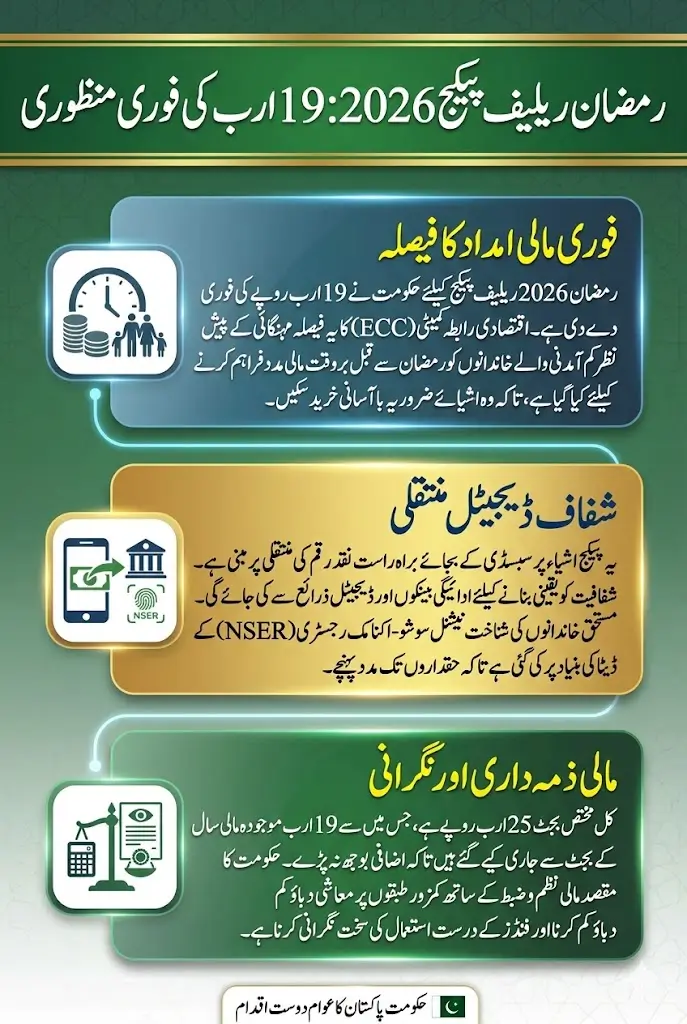
Rs19bn for Ramadan Relief Package 2026 Government of Pakistan has approved the immediate release of Rs19 billion for the Prime Minister’s Ramadan Relief Package 2026, offering timely financial support to low-income families ahead of the holy month. The decision was taken by the Economic Coordination Committee (ECC) to ensure that deserving households receive assistance without delay. At a time when inflation continues to affect essential food items and daily expenses, this move is being seen as a significant step toward social protection and economic relief.
For many Pakistani families, Ramadan is not only a spiritual month but also a period of increased household spending. Grocery bills rise, utility usage increases, and families try their best to maintain traditions despite financial constraints. The approval of funds before Ramadan reflects the government’s attempt to reduce pressure on vulnerable segments of society. By releasing the allocated budget early, authorities aim to ensure smooth disbursement and better planning at the ground level.
You Can Also Read: Nigehban Ramzan Package 2026 New Payment 10000 Get Sitting
ECC Greenlights Immediate Funding to Start Disbursement Process
The Economic Coordination Committee reviewed a proposal submitted by the Ministry of Poverty Alleviation and Social Safety, which requested a total allocation of Rs25 billion for the Ramadan Relief Package 2026. Out of this amount, Rs19 billion had already been included in the current fiscal year’s budget. To avoid administrative delays, the ECC approved the immediate release of this Rs19 billion so that payments could begin promptly.
This decision allows implementing departments to initiate operational arrangements, coordinate with partner banks, and finalize beneficiary verification. Officials have emphasized that early approval will help ensure that eligible families receive financial support before the peak days of Ramadan. The remaining amount from the proposed Rs25 billion will be released later if necessary, depending on actual needs and disbursement progress.
Key highlights of the ECC decision include:
- Immediate release of Rs19 billion to begin cash transfers.
- Total proposed allocation of Rs25 billion for Ramadan 2026.
- Remaining funds to be provided if required.
- Strict compliance with national financial regulations.
- Continuous monitoring to prevent misuse of public funds.
This structured approval process demonstrates a balance between urgent relief and financial responsibility.
You Can Also Read: Ehsaas Rashan Subsidy 2026 Reopened Apply
Financial Structure of the Ramadan Relief Package 2026
The Prime Minister’s Ramadan Relief Package 2026 is designed as a targeted cash assistance program rather than a subsidy-based distribution of goods. The shift toward direct cash transfers allows families to spend according to their specific needs, whether on food items, utilities, or other essentials. It also reduces logistical complications that often arise in physical distribution programs.
By relying on pre-allocated funds within the fiscal budget, the government aims to avoid unnecessary borrowing or additional financial strain. Officials have clarified that any unutilized amount will be returned according to established financial procedures, ensuring accountability at every stage.
The overall financial framework is summarized below:
| Component | Allocated Amount (Rs) | Purpose |
|---|---|---|
| Total Proposed Budget | 25 Billion | Overall Ramadan Relief Allocation |
| Immediate Release Approved | 19 Billion | Direct Cash Disbursement to Beneficiaries |
| Operational Expenses (In-Principle) | 1 Billion | Banking, Communication & Administrative Costs |
This table shows how the government has divided funds between direct relief and operational requirements to ensure smooth implementation.
You Can Also Read: PSER 8070 Registration Online 2026 Punjab Online Apply
Operational Expenses and Administrative Oversight
Alongside the main relief amount, the ECC granted in-principle approval of Rs1 billion for operational expenses. These funds will cover payments to partner banks responsible for disbursement, technology infrastructure, and communication campaigns to inform beneficiaries. Authorities have clearly stated that operational spending must be supported by detailed cost breakdowns.
Financial discipline remains a central focus. Officials have stressed that all expenditures must align with Pakistan’s broader fiscal commitments. Any savings or unspent funds will be surrendered as per official financial rules. This measure is intended to prevent unnecessary spending and maintain public trust in the program.
The operational strategy includes:
- Coordination with partner banks for secure transfers.
- Digital verification systems to confirm beneficiary identity.
- SMS and public awareness campaigns.
- Audit mechanisms for transparent reporting.
- Real-time tracking of fund disbursement.
Such arrangements are aimed at minimizing delays and eliminating the risk of leakages in the system.
You Can Also Read: Maryam Ko Batayein 1000 Helpline To Get 10,000 Ramadan
Transparent Cash Transfers Through Banking and Digital Channels
A key feature of the Ramadan Relief Package 2026 is its reliance on formal banking and digital channels for disbursement. Unlike traditional distribution models, this approach ensures that funds are transferred directly into verified accounts or payment platforms linked to beneficiaries. This method enhances transparency and reduces the role of intermediaries.
Digital disbursement also allows the government to maintain accurate records, making it easier to conduct audits and evaluate program effectiveness. Beneficiaries are expected to receive notifications once funds are credited, ensuring clarity and confidence in the system.
Benefits of digital and banking-based disbursement include:
- Secure and traceable transactions.
- Reduced chances of corruption or favoritism.
- Faster processing of payments.
- Greater convenience for recipients.
- Efficient data monitoring for authorities.
For many citizens, direct cash support through banks offers dignity and independence, allowing families to make their own spending decisions during Ramadan.
You Can Also Read: PSER Online Registration 2026
Beneficiary Identification Through National Socio-Economic Registry NSER
To ensure that assistance reaches the right people, the government will use data from the National Socio-Economic Registry (NSER). This database contains verified socio-economic information about households across Pakistan and is widely used in social protection programs. By relying on NSER data, authorities aim to maintain fairness and transparency in beneficiary selection.
The use of an established registry reduces the risk of political influence or duplication. Only households meeting defined economic criteria will qualify for the cash assistance. This targeted approach strengthens the credibility of the program and reassures taxpayers that funds are being distributed responsibly.
The NSER-based selection process ensures:
- Objective identification of low-income families.
- Data-driven eligibility verification.
- Reduced human interference in selection.
- Transparent record of beneficiaries.
- Alignment with existing welfare programs.
Such measures are crucial for maintaining public confidence in large-scale relief initiatives.
You Can Also Read: 9999 PM Ramzan Relief Package Online Check Status
Balancing Quick Relief with Fiscal Responsibility
While the immediate release of Rs19 billion reflects urgency, the ECC has also emphasized fiscal prudence. Pakistan faces economic challenges, and managing public finances carefully is essential. Officials have reiterated that relief spending must not compromise national fiscal targets or international commitments.
The committee has instructed relevant departments to maintain strict oversight of expenditures and provide regular updates. This dual focus on rapid disbursement and financial discipline reflects a responsible governance approach. By ensuring both speed and accountability, authorities hope to maximize the positive impact of the Ramadan Relief Package 2026.
In practical terms, this means:
- Continuous monitoring of fund utilization.
- Transparent reporting of operational costs.
- Immediate corrective action in case of irregularities.
- Compliance with financial management laws.
- Surrender of unused funds to the national treasury.
This balanced strategy aims to protect both vulnerable families and the country’s financial stability.
What This Means for Pakistani Families in Ramadan 2026
For ordinary Pakistani households, especially those living on limited incomes, timely financial assistance can make a meaningful difference. Rising food prices and utility costs often create additional stress during Ramadan. Direct cash support allows families to purchase essential items according to their priorities without depending on borrowed money.
From a ground-level perspective, early disbursement is critical. When funds are released before Ramadan intensifies, families can plan better and avoid last-minute financial strain. The Ramadan Relief Package 2026, if implemented effectively, can ease economic pressure and strengthen social solidarity during a spiritually important month.
In essence, the approval of Rs19 billion for immediate release signals the government’s commitment to social protection. By combining transparent digital disbursement, NSER-based beneficiary selection, and strict fiscal oversight, Pakistan aims to deliver meaningful Ramadan financial assistance in 2026 while maintaining accountability and responsible governance.