
PSER Survey
The PSER Survey 2026 continues to play an important role in helping the Government of Pakistan identify families that need financial assistance and welfare support. As inflation and rising household expenses continue to affect millions of people, the survey serves as a reliable way to collect updated socio-economic information. Instead of depending on recommendations or manual lists, the government uses verified household data to ensure that relief programs reach deserving families in a transparent and fair manner.
In 2026, completing the PSER Survey is more important than ever because many government assistance programs rely on this information when selecting beneficiaries. Families that keep their records updated have a better chance of qualifying for relief schemes, including Ramzan Rashan packages and cash assistance. Understanding who can complete the survey and how the information is used helps applicants avoid common misunderstandings and stay eligible for future government support.
You Can Also Read: MEPCO Profit Reaches Rs. 1.05 Billion After Remarkable Financial Turnaround
What Is the PSER Survey 2026?
The PSER Survey 2026 is a socio-economic registration process designed to collect accurate information about households across Pakistan. It evaluates the financial condition of families by recording details such as income, employment, family size, housing conditions, and available assets. The purpose of the survey is to create a verified database that allows welfare programs to identify deserving households based on actual economic conditions rather than assumptions.
Unlike one-time registration campaigns, the PSER Survey is part of a long-term welfare system. The information collected can be used for multiple government assistance programs over time, making it easier for authorities to launch emergency relief initiatives without conducting new surveys repeatedly. This approach saves time while ensuring deserving families receive support more efficiently.
The PSER Survey mainly collects information about:
- Household income
- Number of earning members
- Family size
- Housing conditions
- Utility facilities
- Employment status
- Property ownership
- Household assets
Why the PSER Survey 2026 Is Important
The PSER Survey 2026 has become an essential part of Pakistan’s welfare system because it provides the government with verified information about financially vulnerable households. Instead of distributing assistance through manual recommendations, authorities rely on survey data to evaluate poverty levels and determine which families require immediate support. This data-driven approach improves transparency and reduces the chances of unfair distribution.
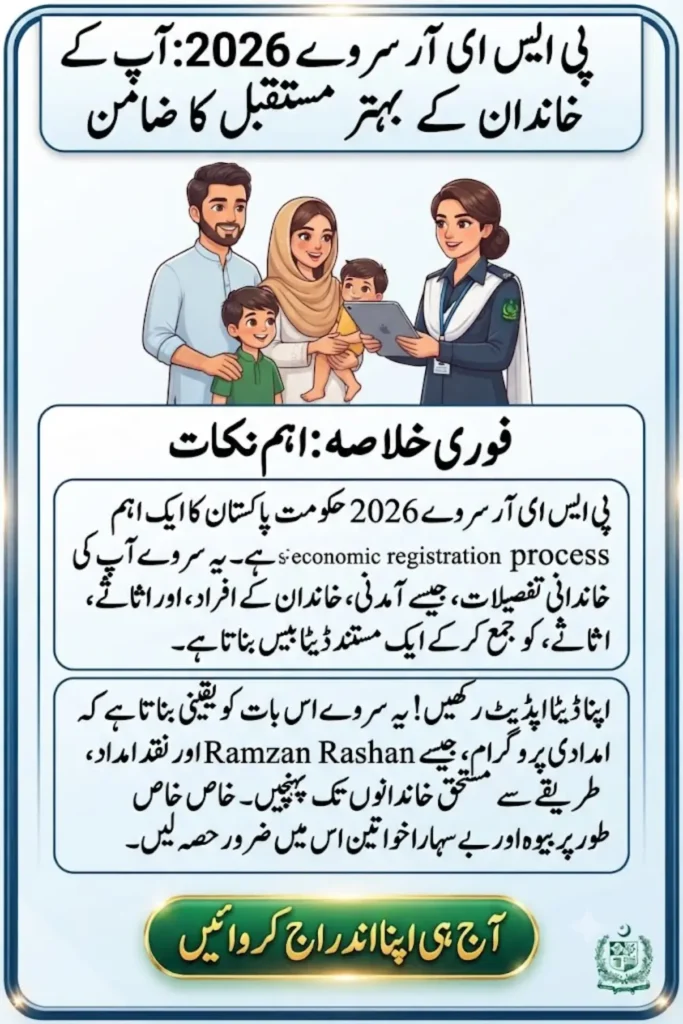
Another important advantage of the PSER Survey is its long-term usefulness. Once a household completes the survey, its information becomes part of a national welfare database that supports various relief initiatives throughout the year. Whether the government introduces Ramzan assistance, emergency cash support, or disaster relief, verified PSER records help speed up beneficiary selection.
The survey supports:
- Fair welfare distribution
- Poverty assessment
- Government planning
- Emergency relief programs
- Transparent beneficiary selection
- Better resource allocation
Who Can Complete the PSER Survey 2026?
The PSER Survey 2026 is intended for families experiencing financial hardship or unstable economic conditions. People often believe they cannot apply if they were previously rejected or registered in another welfare program, but this is not true. The survey remains open to eligible households whose financial circumstances require government assistance. Current household conditions are considered during the evaluation process rather than past decisions alone.
Women managing households are strongly encouraged to participate in the survey, particularly widows and divorced women who often face greater financial challenges. Families with irregular income, disabilities, or multiple dependents are also encouraged to complete or update their information. The goal is to ensure that assistance reaches those who genuinely need support.
Eligible applicants include:
- Female-headed households
- Widows
- Divorced women
- Daily wage earners
- Low-income families
- Families affected by disability
- Households without permanent income
- Financially vulnerable citizens
You Can Also Read: Pakistan Hajj Policy 2027 Approved With New Four-Year Plan Until 2030
Can Previously Rejected Families Apply Again for the PSER Survey 2026?
Yes, families that were declared ineligible in previous years can complete or update the PSER Survey 2026 if their financial situation has changed. A previous rejection does not permanently remove a household from future government welfare programs. Economic conditions often change because of unemployment, illness, inflation, or other financial difficulties, and the survey allows these changes to be reflected through updated information.
Submitting updated household information gives authorities a more accurate picture of the family’s current financial condition. This reassessment helps ensure deserving households are not excluded simply because they failed to qualify under earlier circumstances. Keeping information current increases the chances of being considered for upcoming government assistance programs.
Families should update:
- Household income
- Employment details
- Family members
- Housing information
- Contact details
- Financial condition
Can PSER-Verified Women Receive New Government Benefits?
Women who have already completed the PSER Survey remain eligible for new government welfare programs introduced during 2026. Their verified information is not discarded when new schemes are launched. Instead, the government cross-checks existing records to determine whether applicants continue to meet the required eligibility conditions. This makes the verification process faster and more convenient.
For widows, divorced women, and female-headed households, maintaining updated survey information is particularly important. Since their household details are already available within the welfare database, they often avoid repeating lengthy registration procedures. This helps deserving women receive assistance more quickly when new relief programs become available.
Benefits for PSER-verified women include:
- Existing records remain valid
- Faster eligibility verification
- No complete re-survey in many cases
- Easier access to future welfare schemes
- Quicker approval process
PSER Survey 2026 and PSER Data Linkage
The PSER Survey and PSER work together to improve the accuracy of government welfare distribution. Rather than operating as separate systems, they share verified household information to reduce duplication and ensure deserving families receive assistance fairly. This integration strengthens the government’s ability to identify financially vulnerable households without requiring repeated surveys.
Many applicants worry that joining one system may affect their existing registration in another, but the two databases are designed to complement each other. PSER provides detailed household information, while PSER uses this verified data during eligibility checks for provincial welfare initiatives. Together, they help create a more transparent and efficient welfare system.
The data linkage helps with:
- Faster verification
- Reduced duplicate records
- Better transparency
- Accurate beneficiary selection
- Improved welfare planning
You Can Also Read: HEC Law GAT 2026 Registration Open – Apply Online Before 19 July
Ramzan Relief Benefits After PSER Survey 2026
Households that have completed the PSER Survey 2026 may qualify for Ramzan relief programs if their financial information meets the required eligibility criteria. During Ramzan, the government uses verified survey data to identify families struggling to afford essential food items and other daily necessities. This targeted approach helps ensure assistance reaches those who need it most.
Families with low income, female-headed households, widows, and households without stable employment often receive priority during the selection process. Since eligibility is determined through verified data instead of manual recommendations, the distribution process becomes more transparent and fair for deserving applicants.
Ramzan Relief After PSER Verification
| Category | Details |
|---|---|
| Required Status | PSER Verified Household |
| Main Benefit | Ramzan Rashan 10,000 Qist |
| Verification Method | PSER and PSER Data Matching |
| Priority Groups | Widows, Female-Headed Families, Low-Income Households |
| Survey Requirement | Valid and Updated PSER Information |
Main benefits include:
- Ramzan Rashan assistance
- Cash support programs
- Faster verification process
- Priority for deserving families
- Transparent beneficiary selection
What to Do After Completing the PSER Survey 2026
Completing the PSER Survey 2026 is only the first step toward receiving government assistance. Many applicants mistakenly believe that submitting the survey guarantees immediate financial support, but the verification process continues after registration. The government reviews household information, checks eligibility, and verifies records before selecting beneficiaries for welfare programs. Keeping personal information updated helps avoid unnecessary delays during this process.
Applicants should also pay close attention to official notifications sent through their registered mobile numbers. If contact information changes or verification messages are ignored, eligible families may miss important updates regarding their application. Maintaining accurate records improves the chances of being considered for current and future government relief schemes.
After completing the survey, applicants should:
- Keep their CNIC information updated.
- Ensure the registered mobile number remains active.
- Update household information if circumstances change.
- Respond promptly to verification messages.
- Follow official government announcements.
Eligibility Criteria Checked After the PSER Survey 2026
After a household completes the PSER Survey 2026, the government evaluates several socio-economic factors before determining eligibility for assistance. Instead of relying on a single requirement, multiple indicators are reviewed together to identify families that genuinely need financial support. This comprehensive assessment helps ensure that welfare benefits reach deserving households.
The verification process also considers changes in financial circumstances. Families experiencing unemployment, rising living expenses, illness, or other economic difficulties may still qualify if their updated information reflects their current situation. This flexible approach allows the welfare system to respond more effectively to changing household conditions.
The government reviews factors such as:
- Monthly household income
- Employment status
- Number of dependents
- Housing conditions
- Ownership of property or assets
- Current financial hardship
You Can Also Read: BISP June Payment Update 2026 – How Women Can Receive Payments from Any District
Priority Categories in the PSER Survey 2026
The PSER Survey 2026 gives additional consideration to households facing greater financial and social challenges. Certain groups are considered more vulnerable because they often have limited income sources or increased financial responsibilities. Prioritizing these families helps ensure government assistance reaches those who need it most.
Female-headed households continue to receive special attention under the welfare system. Widows, divorced women, and families without permanent earners frequently face economic instability, making them more likely to qualify for government support. Families caring for disabled members or several dependents may also receive priority during the selection process.
Priority groups include:
- Female-headed households
- Widows
- Divorced women
- Disabled individuals
- Families without permanent earners
- Large low-income families
Digital Verification in the PSER Survey 2026
Digital verification has significantly improved the transparency and efficiency of welfare distribution under the PSER Survey 2026. Instead of relying on manual recommendations or paper records, government departments verify household information through integrated digital databases. This system minimizes errors and helps ensure assistance reaches eligible families without unnecessary delays.
The use of digital verification also reduces duplicate registrations and strengthens accountability throughout the welfare process. Since applicant information is verified electronically, deserving families can receive support more quickly while reducing opportunities for favoritism or misuse of government funds.
Digital verification helps to:
- Improve transparency
- Reduce duplicate registrations
- Speed up eligibility decisions
- Ensure fair beneficiary selection
- Minimize manual errors
Common Mistakes to Avoid During the PSER Survey 2026
Many applicants unintentionally delay their applications by providing incomplete or incorrect information during the PSER Survey 2026. Small mistakes such as entering an incorrect CNIC number or outdated mobile number can prevent successful verification. Carefully reviewing all information before submission can help avoid unnecessary complications.
Applicants should also remember that household circumstances may change over time. Failing to update income, family details, or contact information can affect eligibility for future welfare programs. Keeping records current ensures the government has accurate information when evaluating assistance requests.
Common mistakes include:
- Providing incorrect CNIC details
- Using an inactive mobile number
- Entering incomplete household information
- Failing to update financial changes
- Ignoring official verification messages
Benefits of Completing the PSER Survey 2026
Completing the PSER Survey 2026 provides families with access to a wide range of government welfare initiatives. Since the survey creates a verified socio-economic profile, applicants can be considered for multiple relief programs without repeating the entire registration process. This saves time and allows the government to deliver assistance more efficiently during emergencies and special initiatives.
The survey also improves long-term access to government support by maintaining updated household information within the national welfare system. Families that regularly update their records remain better positioned to benefit from future financial assistance, food support, and other social protection programs.
Benefits of completing the survey include:
- Eligibility for government welfare schemes
- Access to Ramzan Rashan assistance
- Opportunity to receive cash support
- Faster verification for future programs
- Transparent eligibility assessment
- Better chances of receiving government aid
You Can Also Read: CM Punjab Nigehban Ramzan Package 2026 Online Apply For Relief Package Full Guide
Frequently Asked Questions (FAQs)
1. What is the PSER Survey 2026?
The PSER Survey 2026 is a government registration process that collects household socio-economic information to identify families eligible for welfare programs.
2. Who can complete the PSER Survey 2026?
Low-income families, widows, divorced women, daily wage earners, disabled individuals, and financially vulnerable households can complete the survey if they meet the eligibility criteria.
3. Can families rejected in previous years apply again?
Yes. Families whose financial conditions have changed can update their information and may become eligible after reassessment.
4. Can PSER-verified women receive new government benefits?
Yes. Women with verified PSER records may qualify for new welfare programs if they continue to meet the required eligibility conditions.
5. Does completing the PSER Survey guarantee financial assistance?
No. Completing the survey does not automatically guarantee assistance, as every application is reviewed according to the government’s eligibility criteria.
6. What information is checked during verification?
The government reviews household income, employment, family size, housing conditions, assets, and overall financial circumstances.
7. What should applicants do after completing the survey?
Applicants should keep their CNIC, contact information, and household details updated while responding promptly to official verification messages.
8. Why is digital verification important?
Digital verification improves transparency, reduces duplicate records, speeds up eligibility decisions, and helps ensure fair distribution of government assistance.
9. Which families receive priority under the PSER Survey 2026?
Priority is generally given to widows, female-headed households, disabled individuals, families without stable income, and households with multiple dependents.
10. Why should families keep their PSER information updated?
Updated information allows the government to accurately assess current financial conditions and determine eligibility for future welfare programs.
Final Thoughts on PSER Survey 2026
The PSER Survey 2026 remains one of the most important tools for connecting deserving families with government welfare programs in Pakistan. By collecting accurate household information and using digital verification, the government can distribute financial assistance more fairly and efficiently. Families that complete the survey and keep their records updated improve their chances of receiving support during periods of economic hardship.
For low-income households, widows, divorced women, and families facing financial instability, participating in the PSER Survey is an important step toward accessing relief programs such as Ramzan Rashan and cash assistance. Keeping personal information accurate, responding to verification requests, and staying informed about official announcements can help eligible families benefit from future government initiatives.
You Can Also Read: NADRA Pak ID Facial Recognition Verification for Pensioners: Government Ends Bank Visits for Pension Payments