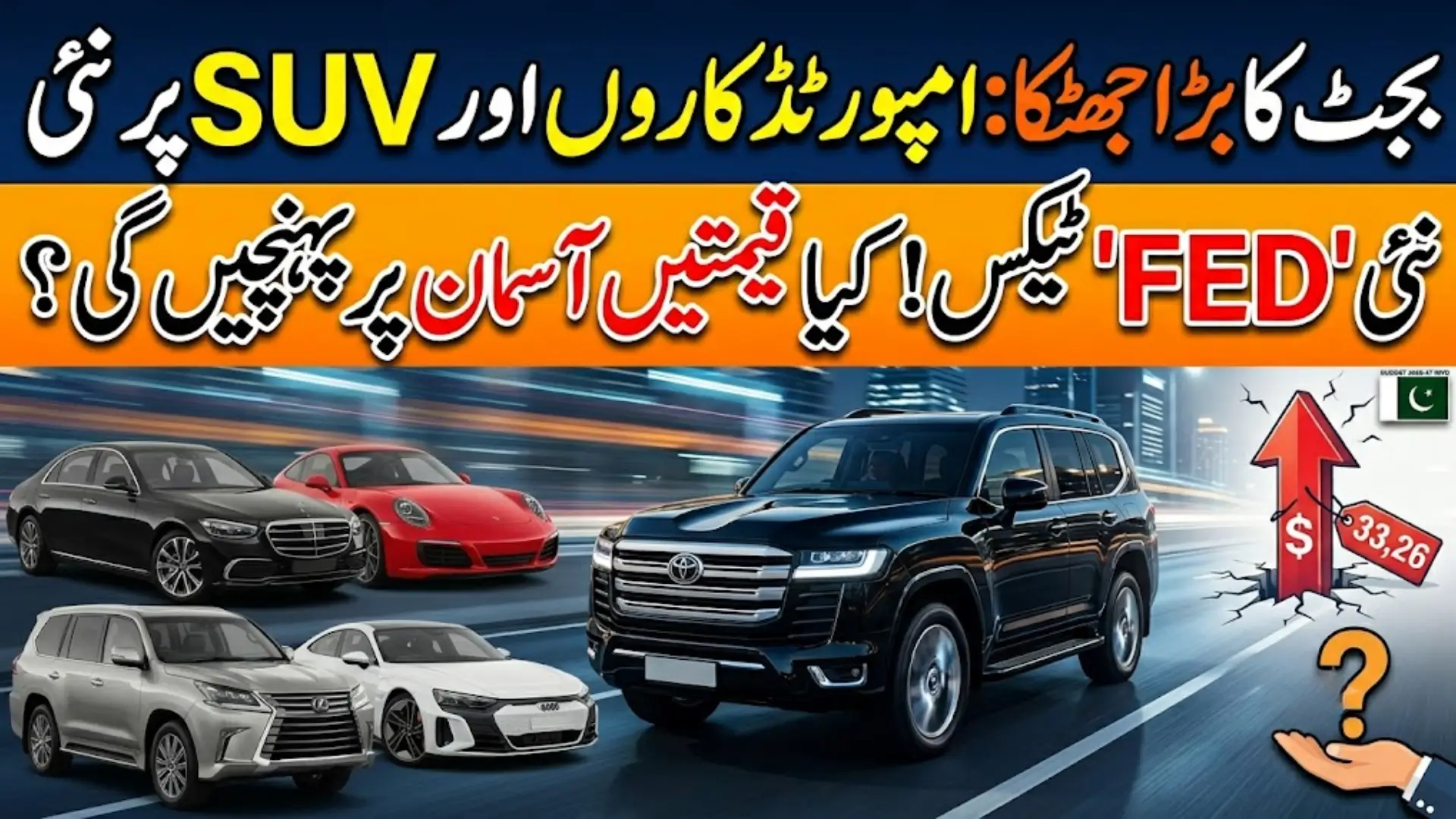
Budget 2026-27 Imported Vehicles Federal Excise Duty
The Federal Budget 2026-27 introduces significant changes for Pakistan’s automobile sector. One of the most discussed announcements is the decision to impose Federal Excise Duty (FED) on imported vehicles, large SUVs, and certain luxury electric vehicles. The government believes that these measures will help ensure a fair distribution of the economic burden while also increasing tax revenues.
Automobile Duty & FED Secure Portal
Secure Validation Active | Fiscal Framework 2026-27
| Tax Structure Line Item | Assessed Value (PKR) |
|---|---|
| Federal Excise Duty (FED) | 0 |
| Customs Import Duty (Estimated Framework) | 0 |
| Standard Revenue Sales Tax | 0 |
| Withholding Operational Tax (WHT) | 0 |
| Total Combined Regulatory Taxes | 0 |
| Initial Declared Base Value | 0 |
| Budget Fiscal Slab Delta (Tax Net Growth) | 0 |
| Post-Budget Estimated Total Cost | 0 |
| Audit Metrics | Pre-Budget Framework | Post-Budget Policy | Absolute Variance |
|---|---|---|---|
| Cumulative Tax Duty | 0 | 0 | 0 |
| Gross Acquired Cost | 0 | 0 | 0 |
Finance Minister Muhammad Aurangzeb announced the new taxation proposals during his budget speech in the National Assembly. The measures primarily target imported vehicles with larger engine capacities and high-value electric vehicles, while relief for smaller electric transportation options will continue.
Key highlights include:
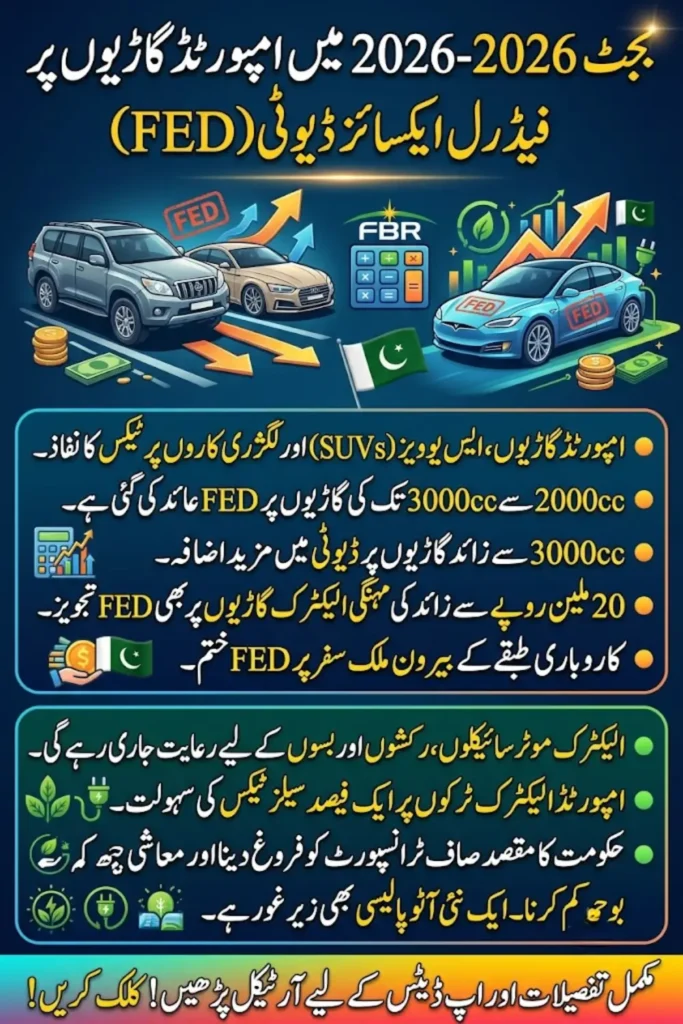
- FED on imported vehicles
- New tax on SUVs from 2000cc to 3000cc
- Increased duty on vehicles above 3000cc
- FED proposed for luxury electric vehicles
- Continued incentives for electric motorcycles and buses
You Can Also Read: Apni Zameen Apna Ghar Scheme 2026 Online Registration Know Full Details Step By Step
Federal Excise Duty on Imported Vehicles
The government has proposed the imposition of Federal Excise Duty on imported vehicles as part of the Budget 2026-27. This move is intended to increase revenue collection while discouraging excessive imports of luxury automobiles. Imported cars have become increasingly popular in Pakistan, making them a significant target for taxation reforms.
Officials believe that taxing imported vehicles can help reduce pressure on foreign exchange reserves while encouraging support for local manufacturing. The policy also aligns with broader fiscal reforms designed to strengthen government revenues during the upcoming financial year.
The new policy covers:
- Imported passenger vehicles
- Imported SUVs
- Luxury imported automobiles
- High-engine-capacity vehicles
New FED on SUVs Between 2000cc and 3000cc
One of the major announcements in the federal budget is the application of Federal Excise Duty on SUVs with engine capacities ranging from 2000cc to 3000cc. These vehicles are often considered premium family vehicles and represent a growing segment of Pakistan’s automotive market.
The introduction of FED on these SUVs is expected to increase their overall cost for consumers. Buyers interested in imported SUVs may face higher prices as importers pass additional tax expenses on to customers.
Vehicles affected include:
- Imported SUVs
- Petrol SUVs
- Diesel SUVs
- Premium crossover vehicles
You Can Also Read: Tax Calculator Pakistan 2026-27 – Income Tax Calculator, Freelancer Tax Calculator
Increased Duty on Vehicles Above 3000cc
The government has also proposed an increase in Federal Excise Duty on vehicles with engine capacities exceeding 3000cc. These automobiles generally belong to the luxury vehicle category and are purchased by high-income individuals.
Officials argue that higher taxes on luxury vehicles create a more balanced taxation structure. Since these vehicles are considered non-essential purchases, the government sees them as an appropriate source of additional revenue generation.
Expected effects include:
- Higher luxury car prices
- Increased import costs
- Additional tax burden on buyers
- Reduced demand for premium imports
Federal Excise Duty on Luxury Electric Vehicles
Electric vehicles continue to gain popularity worldwide, including in Pakistan. However, the Budget 2026-27 proposes Federal Excise Duty on electric vehicles valued above Rs 20 million. The government intends to prevent expensive luxury EVs from benefiting from incentives designed for environmentally friendly transportation.
This proposal specifically targets high-end electric vehicles while maintaining support for affordable electric mobility solutions. The objective is to ensure that tax concessions are directed toward practical transportation options rather than luxury purchases.
Luxury EV categories include:
- Premium electric SUVs
- Imported luxury EVs
- High-value electric sedans
- Electric vehicles above Rs 20 million
You Can Also Read: Freelancer Tax Calculator & FBR Tax Slabs Guide
Relief Continues for Electric Motorcycles, Rickshaws and Buses
While luxury electric vehicles face new taxation proposals, the government has decided to continue the existing concessional system for electric motorcycles, rickshaws, cars, and buses. This reflects Pakistan’s commitment to promoting cleaner transportation and reducing environmental pollution.
The continuation of incentives is expected to encourage the adoption of electric mobility solutions among ordinary consumers and public transportation operators. This strategy balances environmental goals with revenue requirements.
The concessional system supports:
- Electric motorcycles
- Electric rickshaws
- Electric buses
- Affordable electric vehicles
One Percent Sales Tax Facility on Imported Electric Trucks
The government has proposed a one percent sales tax facility for imported electric trucks. This incentive aims to encourage businesses to adopt environmentally friendly commercial transport solutions and reduce dependence on traditional fuel-powered trucks.
Electric trucks can play a significant role in lowering carbon emissions while improving long-term transportation efficiency. The reduced tax rate is expected to attract investment in the electric logistics sector.
Potential benefits include:
- Lower operational costs
- Cleaner transportation
- Green logistics development
- Reduced fuel consumption
New Auto Policy Under Consideration
A new auto sector policy is currently being reviewed by a committee formed by the Prime Minister. According to the Finance Minister, the details of the policy will be presented to Parliament after approval from the Prime Minister and the federal cabinet.
The upcoming policy may introduce further reforms related to vehicle imports, local manufacturing, taxation structures, and incentives for electric vehicles. Industry stakeholders are closely monitoring developments to understand future regulatory changes.
Areas under review include:
- Automobile taxation
- Local vehicle production
- Import regulations
- Electric vehicle incentives
You Can Also Read: Tax Calculator Pakistan 2026-27 – Salary Tax Calculator
Impact of Budget 2026-27 on the Auto Industry
The proposed taxes are expected to affect vehicle prices across several segments. Imported vehicles, luxury SUVs, and premium electric cars may become more expensive due to additional Federal Excise Duty. This could influence purchasing decisions and alter market demand patterns.
At the same time, the continuation of incentives for affordable electric transportation may encourage consumers to explore alternative mobility solutions. The overall impact will depend on how consumers and businesses respond to the new taxation measures.
Expected outcomes include:
- Higher prices for luxury imports
- Increased demand for affordable EVs
- Potential growth in local manufacturing
- Market adjustments by importers
Vehicle Categories Affected by Budget 2026-27
The new taxation proposals target specific vehicle categories while maintaining incentives for others. The following table summarizes the key changes announced in the federal budget.
| Vehicle Category | Budget 2026-27 Proposal |
|---|---|
| Imported Vehicles (2000cc–3000cc) | FED Imposed |
| Imported SUVs (2000cc–3000cc) | FED Imposed |
| Vehicles Above 3000cc | Higher FED |
| Electric Vehicles Above Rs 20 Million | FED Proposed |
| Electric Motorcycles | Incentives Continue |
| Electric Rickshaws | Incentives Continue |
| Electric Buses | Incentives Continue |
| Imported Electric Trucks | 1% Sales Tax Facility |
Key Budget 2026-27 Financial Figures
In addition to vehicle taxation changes, the federal budget contains several important financial allocations and revenue targets. These figures reflect the government’s broader economic strategy for the fiscal year.
Major allocations include spending on defense, pensions, subsidies, and development projects. The government has also set an ambitious tax collection target for the Federal Board of Revenue (FBR).
| Budget Item | Allocation |
|---|---|
| Total Federal Budget | Rs 18,771 Billion |
| Interest Payments | Rs 8,054 Billion |
| Defense Budget | Rs 3,000 Billion |
| Subsidies | Rs 1,091 Billion |
| Pensions | Rs 1,169 Billion |
| Civil Government Expenditure | Rs 1,071 Billion |
| Emergency Allocation | Rs 430 Billion |
| Development Budget | Rs 1,050 Billion |
| FBR Revenue Target | Rs 15,264 Billion |
FED Abolished on Business Class Travel Abroad
Another notable announcement in Budget 2026-27 is the abolition of Federal Excise Duty on business class travel abroad. This measure may reduce travel-related costs for passengers who frequently travel internationally for business purposes.
The decision reflects the government’s effort to balance new taxation measures with selected relief initiatives. Travelers may benefit from lower costs, while the government focuses revenue generation efforts on other sectors.
Key implications include:
- Lower travel taxation
- Relief for business travelers
- Reduced travel costs
- Improved passenger convenience
You Can Also Read: BISP June Payment Update 2026 – How Women Can Receive Payments from Any District
Conclusion
The Budget 2026-27 Imported Vehicles Federal Excise Duty proposals represent one of the most significant changes for Pakistan’s automotive sector in recent years. New taxes on imported vehicles, SUVs, and luxury electric vehicles are expected to increase government revenue while encouraging more balanced taxation across different income groups.
At the same time, incentives for electric motorcycles, rickshaws, buses, and imported electric trucks demonstrate the government’s continued support for environmentally friendly transportation. As the new auto policy moves closer to approval, further developments may shape the future of Pakistan’s automobile industry.
FAQs
What is the new Federal Excise Duty on imported vehicles in Budget 2026-27?
The government has proposed FED on imported vehicles, particularly SUVs and vehicles with engine capacities between 2000cc and 3000cc.
Will vehicles above 3000cc face higher taxes?
Yes, the budget proposes an increase in Federal Excise Duty on vehicles exceeding 3000cc.
Are electric vehicles included in the new taxation proposals?
Yes, luxury electric vehicles costing more than Rs 20 million may be subject to Federal Excise Duty.
Will incentives for electric motorcycles and rickshaws continue?
Yes, the government has decided to continue the existing concessional system for electric motorcycles, rickshaws, and buses.
What is the proposed tax benefit for imported electric trucks?
The budget proposes a one percent sales tax facility on imported electric trucks to encourage cleaner commercial transportation.
You Can Also Read: بی آئی ایس پی جون 2026 ادائیگی اپڈیٹ – اب خواتین پاکستان کے کسی بھی ضلع سے رقم وصول کر سکتی ہیں