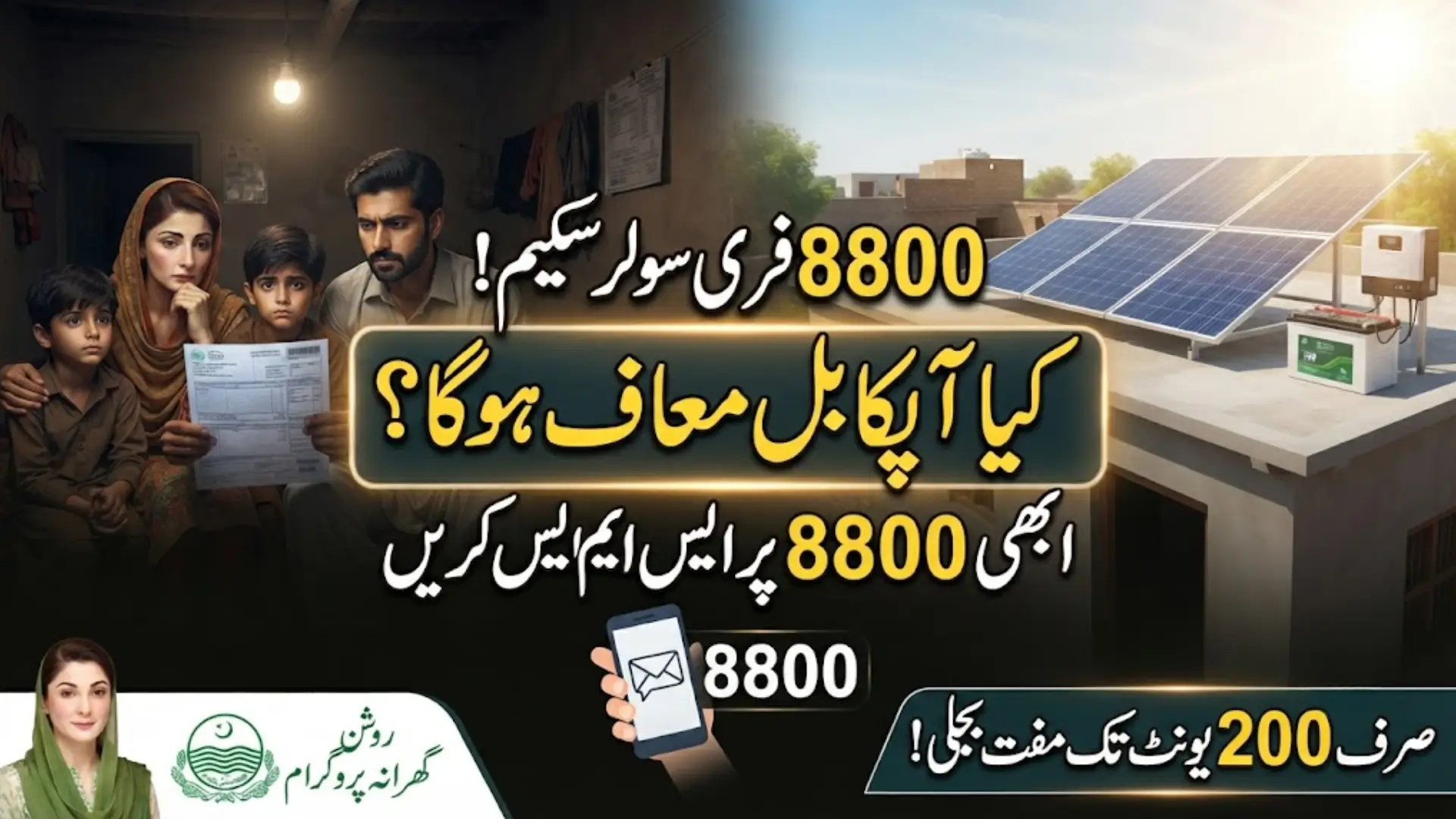
8800 Free Solar Scheme
8800 Free Solar Scheme: Electricity bills have become one of the heaviest burdens on ordinary households across Punjab. For families already stretched thin, a single summer bill can wipe out a week’s grocery budget. That pressure is exactly why the Punjab government’s free solar panel initiative, popularly known as the Roshan Gharana Program, has caught so much attention in 2026.8800 Free Solar SchemeElectricity bills have become one of the heaviest burdens on ordinary households across Punjab. For families already stretched thin, a single summer bill can wipe out a week’s grocery budget. That pressure is exactly why the Punjab government’s free solar panel initiative, popularly known as the Roshan Gharana Program, has caught so much attention in 2026.
At the center of this scheme is a simple SMS shortcode: 8800. This guide walks you through exactly how the program works, who qualifies, and how to register without confusing government jargon.
You Can Also Read: Saudi Arabia FIFA World Cup 2034 Jobs
What Is the CM Punjab 8800 Free Solar Panel Scheme?
The CM Punjab 8800 Free Solar Panel Scheme, launched under Chief Minister Maryam Nawaz Sharif, is a provincial initiative designed to give free solar systems to low-consumption households across Punjab. The government plans to distribute up to 100,000 solar systems free of cost to poor households with electricity consumption between 0 and 200 units. The program is also referred to as the Roshan Gharana Solar Program in several official and media references.
Rather than offering a one-time cash subsidy, the scheme installs a complete rooftop solar setup panels, inverter, and wiring so that a household permanently reduces its dependence on grid electricity. The initiative is built around digital balloting for transparency and links every application to the applicant’s CNIC to prevent theft and duplicate claims. This approach is meant to make the process fair for families in every district, not just those with connections or access to agents.
Understanding the 8800 SMS Registration System
Not every household in Punjab has reliable internet access, which is why the government kept a phone-based option open. Applicants send their electricity reference number followed by their CNIC number to the official shortcode 8800, without using any hyphens or spaces between the digits. This keeps the process usable even for people in remote towns and villages who only have a basic mobile phone.
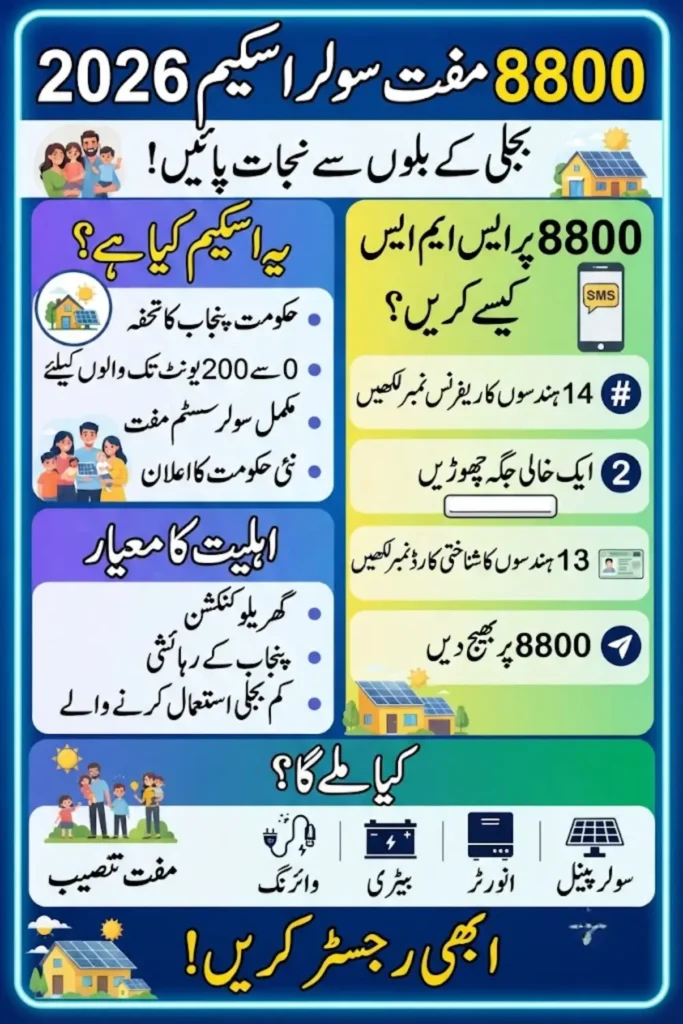
The SMS method isn’t a shortcut around verification it’s simply an alternative entry point into the same system used by the online portal. The service is free to use from every Pakistani mobile network, and applicants typically receive a confirmation reply within a few minutes of sending the message. If no reply arrives, it usually means the numbers were entered incorrectly, so double-checking the format before resending is worthwhile.
You Can Also Read: Pakistan to Train 400,000 Workers for Saudi Arabia
How the SMS Format Works?
Unlike a simple CNIC-only text, the actual format requires two pieces of information together:
- Your 14-digit electricity bill reference number
- A single space
- Your 13-digit CNIC number (no dashes)
The complete message should read as your reference number, followed by a space, then your CNIC number, sent to 8800. Your bill reference number can be found printed on your latest electricity bill or checked through your distribution company’s online billing portal.
Registering Online Through the Official Portal
For applicants with internet access, the online route is generally faster and easier to track. Registration can be completed through the official web portal at cmsolarscheme.punjab.gov.pk, where applicants submit their reference number and CNIC directly.
Once you’re on the portal, you’ll typically be asked to create a basic profile, enter your bill details, and upload a few supporting documents. The portal also allows you to check your application status later using your tracking number, which is a helpful feature if you registered weeks ago and haven’t heard back yet.
You Can Also Read: Government Ends Bank Visits for Pension Payments
Who Is Eligible? Full Criteria Explained
Eligibility isn’t based on guesswork it’s tied directly to your recorded electricity consumption and connection type. Domestic consumers with monthly usage up to 200 units qualify, and consumers with a sanctioned load up to 2 KW are eligible under the scheme. However, consumers involved in electricity theft, those with defective meters, or households with multiple meters at a single residence are excluded from the program.
The scheme divides applicants into consumption-based categories, which determine the size of the solar system a household may receive.
| Consumption Category | Monthly Units | Typical System Size |
|---|---|---|
| Lifeline (Low) | Up to 50 units | Smaller entry-level system |
| Lifeline (Standard) | 51–100 units | 550-watt system |
| Protected | 0–100 units | Free system, no cost |
| Protected (Mid-range) | 101–200 units | 1,100-watt system |
| Unprotected | 101–200 units | Assigned via balloting |
Note: Exact wattage allocations can vary slightly by district and available funding, so the figures above should be treated as general guidance rather than a guaranteed allotment.
Documents You Need Before Applying
Having your paperwork ready before you start saves a lot of back-and-forth later. Missing documents are one of the most common reasons applications get delayed or rejected outright.
- Valid CNIC (original and a clear photocopy)
- Latest electricity bill showing your reference number and consumption in units
- Proof of residence, such as an ownership deed or a No Objection Certificate from your landlord if the property is rented
- Active mobile number registered in your own name, since all updates are sent via SMS
Keep photographs of these documents saved on your phone as well. This makes the online form much quicker to fill out, especially if you’re applying from a mobile browser rather than a computer.
You Can Also Read: NADRA Pak ID Facial Recognition Verification for Pensioners
What Happens After You Submit Your Application?
Submitting your reference number and CNIC is only the first step. From there, your application moves through a structured review process before any installation happens.
The Balloting Process
Because millions of households apply for a limited number of systems, the government relies on a computerized draw to keep the process fair. Since application volumes regularly run into the millions, an automated and transparent computerized balloting system is used to select the final beneficiaries. This means meeting the eligibility criteria puts you in the pool of candidates, but it does not guarantee automatic selection.
Physical Verification
If your application is shortlisted, the next stage involves a real visit to your home. Technical verification teams and district administrative staff visit selected applicants to check roof space and confirm the structure is suitable for installation. Officials generally also confirm that your address and household details match what was submitted in your application. Skipping this visit or being unavailable when the team arrives can delay or cancel your selection.
What You Receive If Selected?
Once your household clears verification, the government arranges installation through approved vendors at no cost to you.
| Package Component | Details |
|---|---|
| Solar Panels | 1kW to 3kW depending on consumption level |
| Inverter | Certified system included |
| Battery Backup | Provided to support usage during load-shedding |
| Installation | Done by government-assigned vendors, free of charge |
| Net Metering | May be available where permitted by the distribution company |
Most beneficiary households report monthly savings of roughly PKR 3,000 to PKR 6,000 or more on their electricity bills after the system is installed, though actual savings depend on your household’s usage pattern and local sunlight conditions.
You Can Also Read: MEPCO Profit Reaches Rs. 1.05 Billion After Remarkable Financial Turnaround
Common Mistakes That Delay Applications
Many otherwise-eligible families lose their place in the process because of small, avoidable errors. Being careful at the registration stage prevents most of these problems.
- Sending the SMS with spaces, dashes, or an incorrect CNIC format
- Leaving out the bill reference number or entering it incorrectly
- Ignoring calls or messages from the verification team
- Believing agents who claim they can guarantee faster approval for a fee
- Changing your SIM card or phone number during the application period
The entire process, from SMS to installation, is designed to be free. Any request for payment to speed things up should be treated as a red flag.
Final Thoughts
The 8800 Free Solar Scheme 2026 gives Punjab households a genuine, no-cost path toward lower electricity bills and more reliable power during outages. The process is straightforward: check your bill reference number, send the correct SMS format to 8800 or register online, keep your documents ready, and stay available for the verification visit.
If your household’s monthly consumption falls within the eligible range, there’s little reason to wait. Confirm your details are accurate, apply through the official channels only, and keep your phone active for updates.
You Can Also Read: Pakistan Hajj Policy 2027 Approved With New Four-Year Plan Until 2030
Frequently Asked Questions
1. What is the correct SMS format for the 8800 solar scheme?
Send your 14-digit electricity bill reference number, followed by a space, then your 13-digit CNIC number, to 8800. Do not include dashes or extra spaces.
2. Is there any fee to register for this scheme?
No, registration through both SMS and the official online portal is completely free. Anyone asking for payment is not part of the official process.
3. How do I know if I’m eligible for the free solar panels?
Households with monthly electricity consumption up to 200 units and a sanctioned load up to 2 KW generally qualify, provided there’s no history of theft or meter tampering.
4. How long does it take to get selected after applying?
Selection depends on computerized balloting due to high application volumes, so timelines vary. Applicants are notified by SMS once shortlisted for verification.
5. What happens during the home verification visit?
A technical team checks your roof space, structural safety, and confirms your address matches your application before final approval is granted.
You Can Also Read: HEC Law GAT 2026 Registration Open – Apply Online Before 19 July